Early Methodism in Bath
by Richard Card
In August of 1793, the easterly session of the New England Conference met in Lynn, Massachusetts. Although there were then only some 300 Methodists in the whole district, travel was difficult, and a call went out for new preachers. Appointed to the “Province of Maine and Lynn” was Jesse Lee, who must have been staggered by the size of his new circuit. He reached Bath a little over a month later, on September 12, 1793. He preached three times and organized a class of six members, bringing Methodism to Bath before passing on to other towns in his circuit. In the years that followed, supply preachers were irregular. Early converts to Methodism were often poor and uneducated. Preachers were exhorters and were entertained in the homes of the converts. Methodists were looked down upon by the orthodox churches and were considered a persuasion rather than a denomination.
In 1800, Timothy Merritt served as supply, rowing down from his home in Bowdoinham on Sunday mornings and returning in the same way at day’s end. In 1806, however, General James McLellan and his wife Lydia moved to Bath with their 13 children. Mrs. McLellan, along with a Mrs. Blake and a Mr. Berry, eventually formed a class that met for nine years in a small building in the McLellan shipyard. In 1816, an exhorter named Scribner came to town to conduct a revival that brought some 200 conversions, but there was as yet no place of worship for more than a handful of Methodists, so most of these converts found homes in other churches. The next year Rev. John Wilkinson, a Methodist minister retired from circuit preaching because of ill health, moved to Bath as a druggist and began preaching frequently in the Town Meeting House (on Witch Spring Hill), at the old Bath Academy, and elsewhere.
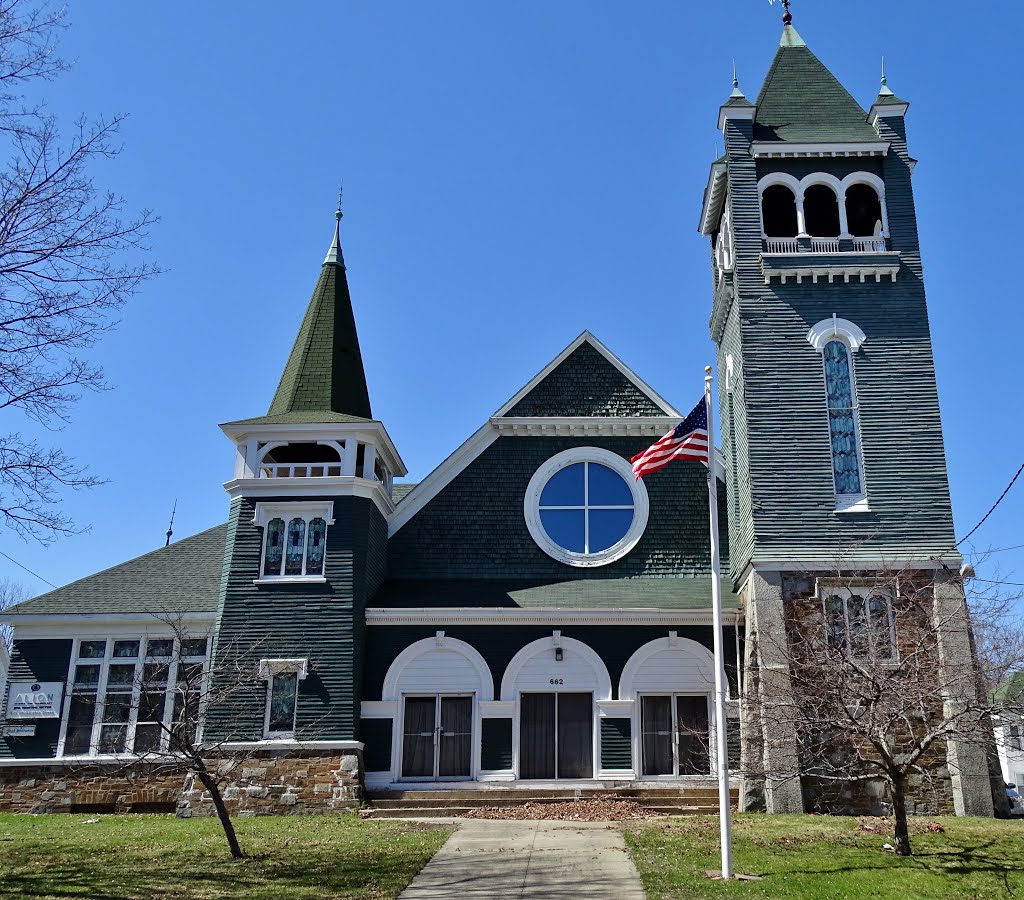
In 1847 the austere Meeting House was embellished by the erection of a more elaborate facade crowned by a tower and spire, for all of which joiner Isaac Cole was paid $400. General James McLellan and William Crooker then gave a bell for the tower. But in 1852 the Official Board of the growing society decided “with perfect unanimity” that, since many of the church members lived at the North End at a considerable distance from the building, a new society should be organized for them in the northern part of Bath. Charles Davenport, Isaac Linch, and Isaac Hatch were elected as a building committee for this new society, and in the next year Beacon Street Church was built. Seventy members of the parent church left to form the new society. Since each organization now needed a name, the older church chose to be called Wesley Methodist Episcopal Church.
Wesley Church:
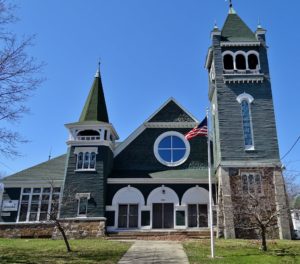
A sweeping revival occurred in the early 1870s, resulting in many conversions at the Wesley Church. Church debt was reduced and in 1873 a magnificent pipe organ, one of the finest in Maine, was installed in the balcony at the back of the church. In spite of many challenges along the way, including devastating fire, in 1920 the Wesley Church celebrated its hundredth anniversary and continued to fulfill its mission in the following decades. In the 1940s Wesley Church was said to have “prospered spiritually and materially.” Extensive restoration work was done to the building both outside and inside, and in 1951 the Annual Conference of the Maine Methodist Conference was held here.
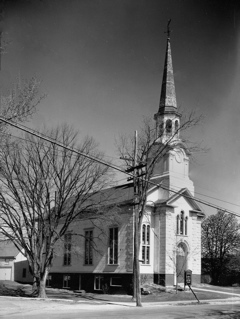
Beacon Street Church:

By the early 1870s, the Beacon Street Methodist Episcopal Church was filled for most services, and religious interest was such that extra seats often had to be brought in. In 1902, the Beacon Street Church completed a major renovation of its interior. The organ was moved from the back of the church to the front, a steel ceiling was installed, memorial stained glass windows were given, and walls and woodwork were freshly painted. It was also in 1902 that the first women were added to the Board of Stewards.
The prized painting of “The Lord’s Supper,” painted by Neil C. Gielstrup and based on the DaVinci original, was first loaned to the church by Capt. Guy C. Goss, then donated by his daughter in his memory. It is impressive to note that Rev. Howard Cramer, while still attending Boston University School of Theology, received 94 into church membership and baptized 89 children and adults during his first two years as pastor there. The congregation continued to spread the Gospel and to be an active participant in the civic, spiritual, and social life of the community throughout the years of the Great Depression, World War II, and after. In June of 1953, Beacon Street Church celebrated its one hundredth anniversary with a week of special services.
Bath United Methodist Church:

In 1967, Rev. Lewis Beckford was assigned as pastor of both Wesley Church and Beacon Street Church, in response to the changing conditions of that era. For a time, services were held on alternate Sundays at each of the churches, and then discussions began on the possibility of combining the two congregations that had separated more than a century earlier.
In 1970, a Joint Committee on Merger evaluated the adequacy of each church building in terms of capacity, accessibility, parking, church school space, and other facilities, along with the likely cost of necessary upgrades (Also in 1968, the denominations of the Methodist Episcopal Church and the Evangelical United Brethren Churches merged to form the United Methodist Church). A Joint Conference was held in September 1970, followed by the two individual Church Conferences, and the decision was made to merge the two churches, to use the former Beacon Street building for the combined congregation, and to sell the former Wesley Church building to the Bath Iron Works for use as a Navy dining facility. Subsequent decisions were made to continue to use the former Wesley parsonage as home for the pastor of the new United Methodist Church and to remodel the former Beacon Street parsonage for use as Sunday School rooms and an office. Rev. Ralph Miller followed Mr. Beckford in 1972, and he in turn was followed by Rev. James Word in 1977.
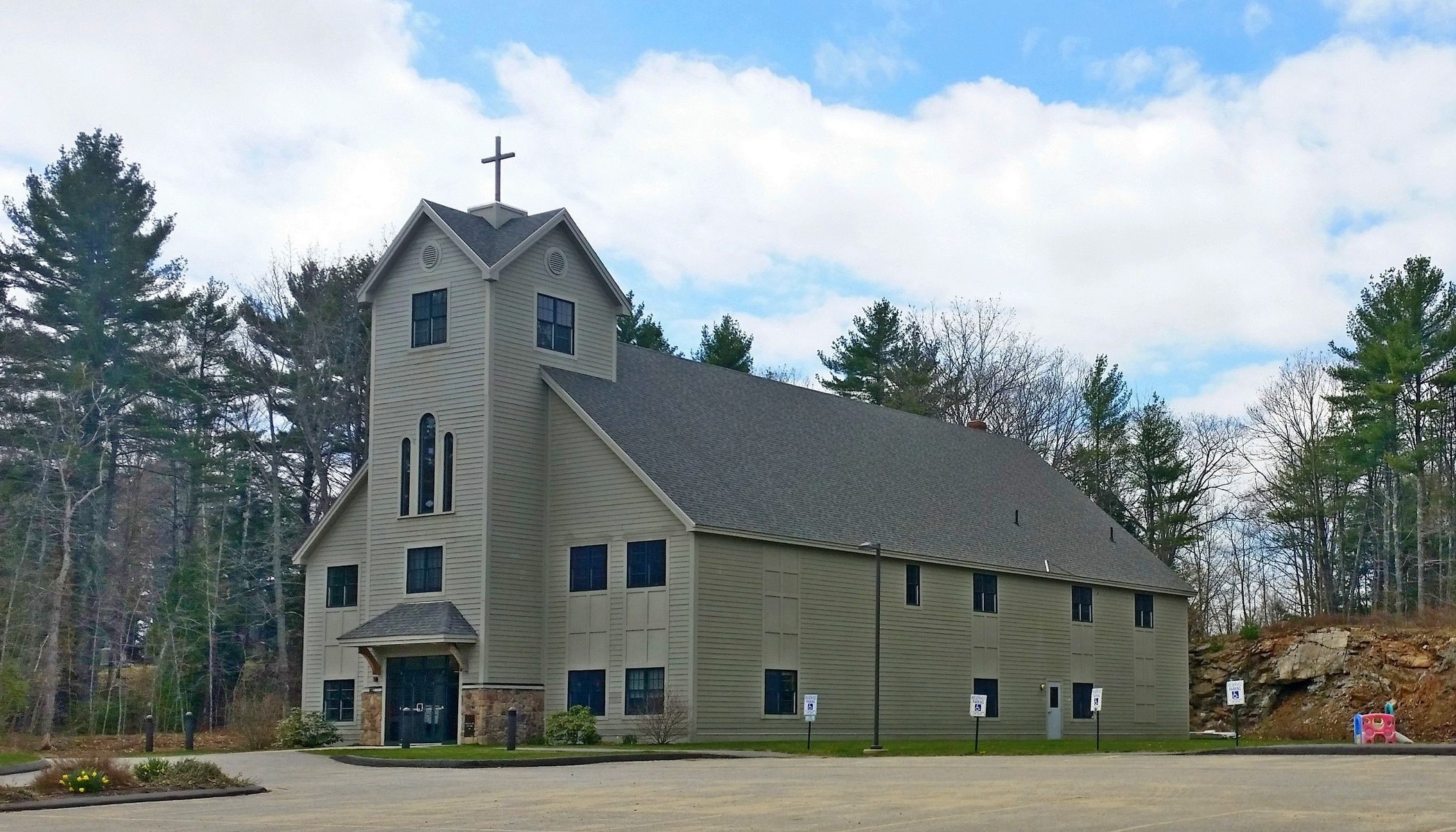
On August 5, 1981, lightning struck the church spire and jumped unseen to the steel ceiling of the sanctuary. The resulting fire destroyed the roof, spire, and belfry, and the interior sustained extensive water damage. Although the building was repaired, by the end of the twentieth century the Bath United Methodist had become increasingly aware of the inadequacy of church school space and, especially, the lack of parking in an age when most people come to church by automobile. A much larger lot of land was purchased on Oak Grove Avenue, preliminary architect’s drawings were made for a new church complex for the twenty-first century, and substantial initial funds were raised.
Phase 1 of the building was completed in 2007, which included the completion of the entire first floor and partial completion of the second floor; the design includes a large sanctuary attached to the main building. Until this sanctuary can be built, worship is held in the large fellowship hall, and two Sunday School classrooms, a chapel, and a library have been completed upstairs. And in keeping with our Methodist tradition of service to the world in obedience to Christ, we look forward to the future.
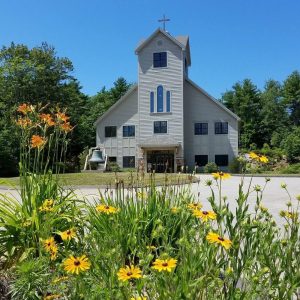
You may obtain a complete history, including early photos, by contacting the church office and visiting our library to view our extensive records.
Bath United Methodist Church Pastors: 1970- Present
Lewis H. Beckford 1970-72
Ralph L. Miller 1972-77
James H. Word 1977-83
Vicki Woods 1983-90
K. Joy Toll 1990
Donald E. MacInnis 1991 (acting)
Joel Guillemette 1991-98
Russell Peppe 1998-2005
Beverly Blaisdell 2005-07
Neil Gastonguay 2007-2016
Gwyneth Arrison 2016-2021
R Kelly Harvell 2021-2023
Ernest Farrar 2023-2026
Alice Mello 2026 - Present
Beacon Street Methodist Church Pastors:
Henry M. Blake 1853-55; Howard B. Abbott 1855-57; Andrew J. Church 1857-59; Herman Nickerson 1859-60; L. F. Wetherbee 1860-62; Henry M. Blake 1862-64; Caleb Fuller 1864-66
J. E. C. Sawyer 1866-69; Charles Munger 1869-71; Roscoe Sanderson 1871-73; Kinsman Atkinson 1873-75; Leonard H. Bean 1875-78; Enos T. Adams 1878-81; William S. Jones 1881-84
Gershom F. Cobb 1884-85; H. E. Foss 1885-87; Thomas Whiteside 1887-90; W. F. Holmes 1890-91; Merritt C. Pendexter 1891-96; D. E. Miller 1896-98; C. F. Parsons 1898-99; Woodbury F. Merrill 1899-1903; Hosea Hewitt 1903-05; George D. Stanley 1905-09; Nathaniel B. Cook 1909-13; Thomas N. Kewley 1913-18; E. Hilton Post 1918-21; John R. Browne 1921-22; John G. Rogers 1922-23; E. Lewis Wall 1923-25; Weston P. Holman 1925-34; Harley A. Shattuck 1934-37; Jesse Kenderdine 1937-41; Charles L. Kinney 1941-46; Alfred H. Ives 1946-49; Murchie A. Gordon 1949-50; Howard F. Cramer 1951-54; Oliver W. Bell 1954 (acting); Richard Arnold 1955-58; Frederick L. Niles 1958-62; James W. Daniels 1963-67; Lewis H. Beckford 1967-70
Wesley Methodist Church Pastors: Charles Virgin 1819-21 Sullivan Bray 1821-22 Bartholomew Otheman 1822-23 Joseph White 1823-24 Wilder B. Mace 1824-26 Sullivan Bray 1826-27 William H. Norris 1827-29 John B. Husted 1829-30 Green Grove Moore 1830-31 Justin Spaulding 1831-32 John Atwill 1832-33 Stephen Waterhouse 1833-34 Isaac Downing 1834-35 James Thwing 1835-36 John W. Atkins 1836-37 William H. Pillsbury 1837-38 Caleb Fuller 1838-40 George Webber 1840-41 Eton Shaw 1841-43 Charles W. Morse 1843-45 John Hobart 1845-46 Stephen Allen 1846-47 Gershom F. Cox 1847-48 Paul C. Richmond 1848-49 William F. Farrington 1849-51 Charles F. Allen 1851-53 Parker Jaques 1853-55 Asahel Moore 1855-56 Ezekiel Robinson 1856-58 James McMillan 1858-60 Silas H. Hyde 1860 Joseph L. Morse 1860-61 R. H. Stinchfield 1861-62 Seba F. Wetherbee 1862-63 Luther T. Townsend 1863-64 Cyrus A. King 1864-67 Joseph Hawkes 1867-69 William S. Jones 1869-72 James Roscoe Day 1872-75 Ammi S. Ladd 1875-77 Abel W. Pottle 1877-81 William S. Sterling 1881-82 Ammi S. Ladd 1882-84 E. S. Stackpole 1884-87 J. L. Hill 1887-88 L. L. Hanscom 1888-89 A. A. Lewis 1889-93 S. T. Westhafer 1893-95 Joseph L. Hoyle 1895-96 J. T. Crosby 1896-1900 David B. Holt 1900-09 Charles W. Bradlee 1909-13 H. A. Corey 1913-15 C. W. Harrison 1915-18 Frank H. Hall 1918-22 Charles E. Brooks 1922-26 F. L. Littlefield 1926-34 Ernest Heywood 1934-40 Chester B. Oliver 1940-48 Clifford C. Sargent 1948-52 Howard D. Hull 1953-54 Oliver W. Bell 1954-62 Robert L. Rand 1962-66 Lewis H. Beckford 1967-70
History, photos, and other historical objects are available in our library. Please come for a visit!
 Our Pastors
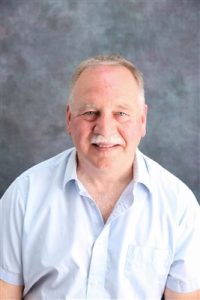
Pastor Ernie Farrar, Served BUMC 2023-2026, Retired
Pastor Ernie served Bath UMC and New Harbor UMC as a Part-time Minister from 2023-2026, leading services at both communities on Sundays and splitting his time during the week between the two locations and serving the parishioners as he is needed.
His passion is seeking a balance of boldness for the kingdom and humility of being a human as a daily journey. He strives to fully live a life that is a seamless response to a relationship with God and others.
Ernie has 38 years of experience in the pastoral role, alongside his 22 years of service in the military. He served for four years in the United States Air Force and eighteen years in the Navy Reserve, with part of his time in the Navy Reserve split between the Marines and the Coast Guard. A large portion of his service was based at the Brunswick Naval Air Station in Brunswick, Maine, about 20 minutes from Bath.
As a Pastor, he loves going back to the spiritual basics as a way of renewing lives. He has served on approximately a dozen Tres Dias and Walk to Emmaus retreats over the years, and the Disciple Bible studies he has led have been an instrument of spiritual renewal for many.
Serving the youth and children in Christian leadership has also been a long-standing passion for Ernie as he has volunteered for 30 years as a counselor and dean for the camps held at Mechuwana in Winthrop, Maine. His love of soccer has resulted in his coaching elementary soccer camps as well as coaching in town and school leagues where he has lived.
Ernie is a devoted family man and has been married to Joan for 45 years, and they have three sons and ten grandchildren. He counts Grandpa as his greatest promotion. In the rare free time that he is not busy serving his community, his hobbies include hiking, vegetable gardening, photography, and woodworking.